War Made Invisible – How America Hides the Human Toll or Its Military Machine


Recent Articles:
- How Hakeem Jeffries and J Street Teamed Up for Arming Genocide
- House Democrats are finally shifting on Israel. Party leaders must listen
- Politicians Should Stop Hiding Behind the “Two-State Solution” Fantasy
- Today’s cautious AOC would not have endorsed the AOC of 2018
- My Conversation With Karl Marx About Donald Trump
-
The Madness of Militarism
By Norman Solomon / The Massachusetts Review
Editor’s note: On November 15, 2023, Norman Solomon delivered the Second Annual Ellsberg Lecture at the University of Massachusetts Amherst, a lecture series hosted by University’s Ellsberg Initiative for Peace and Democracy. The text below is based on a transcript of his remarks, excerpted and edited for publication. In 2019, Ellsberg made UMass the home for his papers; with the help of an anonymous donor, this treasure trove of some 500 boxes of material became part of the Robert S. Cox Special Collections and University Archives Research Center.
One day in 1995, I called Daniel Ellsberg and suggested that he run for president. His response was instantaneous. He said, “I'd rather be in prison.” He then explained, “I can't imagine how awful it would be to keep talking about things I don't know much about.” That doesn't seem to stop many candidates for president, but for Dan, it was a no-go.
I've thought about that conversation many times. And it's often made me return to an essential question. What exactly did Dan Ellsberg know? From inside the U.S. war machine, he knew what almost no one who had reached his level was willing to talk about publicly. What he knew, and most importantly, what he was willing to share with the public was that the leaders of the so-called Defense Department, the State Department, and the people in the Oval Office, not only could lie, they did so frequently, without regard for truth and without regard for human life. That realization—and the willingness to share that truth—is as current and crucial at the end of 2023 as it was in 1971, when the Pentagon Papers were released.
A couple of years ago, when I recorded an interview with Dan Ellsberg, this is how he put it,
That there is deception, that early in the game the public is evidently misled by it in a way that encourages them to accept and support war is the reality. How much of a role does the media actually play in this—in deceiving the public? And how difficult is it to deceive the public? As an insider, one becomes aware: it's not difficult to deceive them. First of all, you're often telling them what they would like to believe—that we're better than other people, that we are superior in our morality and in our perceptions of the world.
In The Doomsday Machine, a book as important as any I've ever read, Dan starts with an epigraph from Friedrich Nietzsche: “Madness in individuals is something rare. But in groups, parties, nations, and epochs, it is the rule.”
I often think of that quote in tandem with what the Rev. Dr. Martin Luther King, Jr. described as “the madness of militarism,” something that is as real in our day as when he uttered those words in 1967. Dr. King spoke about what he called the “demonic, destructive suction tube” that drew tremendous quantities of resources away from this country—from human well-being, from health care, education, housing, infant care, elderly care, you name it. Walk around Massachusetts or California or any other state, and you won't be far from the deficits—the result, in large measure, of that “demonic, destructive suction tube.”

A quick survey. Has anyone here—in your neighborhood, in your community, in your travels in the United States, in the last year or two—ever seen a flag of the nation of Ukraine? Please raise your hand. Ukrainian flag, anybody? Wow, almost the whole room. Almost everybody here has seen this display of solidarity with the humanity of the Ukrainian people, who are suffering a horrific invasion—warfare imposed on them by another country. A truly appropriate display of solidarity and compassion.
Now, the other half of my survey. Please raise your hand if you've seen displayed—in your neighborhood, in your walk of life, in your community, or in your travels across the United States—a flag of the country of Yemen. I’m not seeing a single hand. And I can't raise my hand either. Every day when I go shopping or go to work in my little office, I see the flags of Ukraine. I don't see any Yemeni flags.
You may remember the fist bump when, in the middle of 2022, President Biden met with the de facto ruler of Saudi Arabia. That was a gesture of solidarity, between our country, which has sold billions of dollars worth of weapons and provided intelligence, and Saudi Arabia, as it slaughters civilians in Yemen.
The media watch group FAIR did a study of MSNBC, the liberal network (not Fox). It found almost no coverage whatsoever of the slaughter going on in Yemen. During the Trump administration, there was 5,000% more coverage of the Russiagate narrative than of what was happening in Yemen.
Ever since 2015, the U.S. government has been supporting the killing from the air and the massacres by Saudi Arabia of people in Yemen. We might think the lack of coverage is odd, given that the United States government is directly involved. And yet, despite our involvement, the U.S. media is hardly paying any attention to it at all. Remember, after the invasion of Ukraine, there was huge coverage—empathetic coverage, appropriate coverage—of the suffering on the ground in Ukraine. That was apparently a different tier of grief, one that's officially sanctified and encouraged. In Yemen, when children were dying en masse, when the largest cholera epidemic in modern history was taking place (courtesy of the Saudi regime, with the support of the United States), it wasn’t newsworthy.
-
President Biden: Learn the Names of Children You’ve Helped Israel to Murder
By Norman Solomon
To: President Joe Biden
You’ve often spoken of how much you care about children and how terrible it is when they’re murdered. “Too many schools, too many everyday places have become killing fields,” you said at the White House last spring on the one-year anniversary of the school shooting in Uvalde. At the time of that tragedy in Texas, you had quickly gone on live television, speaking gravely.
“There are parents who will never see their child again,” you said, adding: “To lose a child is like having a piece of your soul ripped away. . . . It’s a feeling shared by the siblings, and the grandparents, and their family members, and the community that’s left behind.”
And you asked plaintively: “Why are we willing to live with this carnage? Why do we keep letting this happen? Where in God’s name is our backbone to have the courage to deal with it and stand up to the lobbies?”
This year you’ve asked similar questions many times, as in the aftermath of shootings at a grade school in Nashville, Michigan State University and the University of Nevada.
The massacre in Uvalde took the lives of 19 children. For nearly three months, the ongoing massacre in Gaza has taken the lives of that many children every few hours.
In mid-November, after five weeks of Israel’s bombing of Gaza, the director-general of the World Health Organization reported that children were being killed at an average rate of six per hour, adding that “nowhere and no one is safe.” Palestinian civilians of all ages continue to undergo slaughter, with the death toll surpassing 20,000.
You have continued to voice support for Israel’s military assault on Gaza and its residents. After 10 weeks of the carnage, when you got around to expressing a bit of concern about Israel’s “indiscriminate bombing,” you were meanwhile still doing everything you could to greenlight and fast track massive U.S. shipments of weapons and ammunition to Israel so that the indiscriminate bombing could continue.
Even your belated and inadequate words on Dec. 12 about “indiscriminate bombing” apparently caused you to have second thoughts. The next day, Voice of America reported that “the White House appears to be walking back” your comment about “indiscriminate bombing.”
Most important, of course, are not words but deeds. As commander-in-chief, since early October you have approved large-scale shipments to Israel of 2,000-pound bombs — described by the New York Times as “one of the most destructive munitions in Western military arsenals,” a weapon that “unleashes a blast wave and metal fragments thousands of feet in every direction.”
In a Dec. 21 video report based on analysis of “aerial imagery and artificial intelligence” — headlined “Visual Evidence Shows Israel Dropped 2,000-Pound Bombs Where It Ordered Gaza’s Civilians to Move for Safety” — the Times indicated that “Israel used these munitions in the area it designated safe for civilians at least 200 times.” Those 2,000-pound bombs have been “a pervasive threat to civilians seeking safety across south Gaza.”
Since the war in Gaza began 11 weeks ago, the Times reported, “the U.S. has sent more than 5,000 2,000-pound bombs” to Israel. And after a long phone conversation with Israel’s Prime Minister Netanyahu on Dec. 23, you told the press: “I did not ask for a ceasefire.”
With your ongoing help, Israel is continuing to murder children and other civilians in Gaza just as methodically as the gunman murdered children at the elementary school in Uvalde. And you have continued to provide weaponry for the murders just as surely as the gun shop in Uvalde sold firearms and ammunition to the man who went on to kill at the elementary school.
But that is an unfair comparison — unfair to the Uvalde gun-shop owner, who did not know the intended use of the weapons and ammo. But you know what the billions of dollars’ worth of weapons and bombs gifted by the U.S. government are being used for.
When three 9-year-old students were among those shot to death at a school in Nashville last March, you spoke about them the next day. “A family’s worst nightmare has occurred,” you said. “Those children should all be with us still,” you said. And you said: “We know the names of the victims.”
But you don’t know the names of the children you’ve helped to murder in Gaza. And there are so many.
Norman Solomon is the national director of RootsAction.org and executive director of the Institute for Public Accuracy. He is the author of many books including "War Made Easy." His latest book, "War Made Invisible: How America Hides the Human Toll of Its Military Machine," was published in 2023 by The New Press.
-
Unilateral Sanity Could Save the World
By Norman Solomon / TomDispatch
Top American officials in the “national security” establishment are notably good at smooth rhetoric and convenient silences. Their scant regard for truth or human life has changed remarkably little since 1971 when Daniel Ellsberg risked decades in prison to leak the Pentagon Papers to the world. During the years between then and his death six months ago, he was a tireless writer, speaker, and activist.
Most people remember him, of course, as the whistleblower who exposed voluminous official lies about the Vietnam War by providing 7,000 top-secret pages of classified documents to the New York Times and other newspapers. But throughout his adult life, he was transfixed above all by the imperative of preventing nuclear war.
One day in 1995, I called Dan and suggested he run for president. His reply was instant: “I’d rather be in prison.” He explained that, unlike typical candidates, he couldn’t stand to offer opinions on subjects he really knew little or nothing about.
However, for more than five decades, Ellsberg didn’t hesitate to publicly address what he really did know all too much about — the patterns of government secrecy and lies that sustained America’s wars in one country after another, along with the chronic deceptions and delusions at the core of the nuclear arms race. He had personally seen such patterns of deceit at work in the upper reaches of the warfare state. As he told me, “That there is deception — that the public is evidently misled by it early in the game… in a way that encourages them to accept a war and support a war — is the reality.”
And how difficult was it to deceive the public? “I would say, as a former insider, one becomes aware: it’s not difficult to deceive them. First of all, you’re often telling them what they would like to believe — that we’re better than other people, we are superior in our morality and our perceptions of the world.”
Dan had absorbed a vast array of classified information during his years working near the top of the U.S. war machine. He knew countless key facts about foreign policy and war-making that had been hidden from the public. Most importantly, he understood how mendacity could lead to massive human catastrophes and how routinely the key figures in the Pentagon, the State Department, and the Oval Office openly lied.
His release of the Pentagon Papers in 1971 — revealing crucial history about the Vietnam War while it was still underway — exposed how incessant deception got wars started and kept them going. He had seen up close just how easy it was for officials like Secretary of Defense Robert McNamara to suppress doubts about American war-making and push ahead with policies that would, in the end, lead to the deaths of several million people in Vietnam, Laos, and Cambodia. And Dan was haunted by the possibility that someday such deception might lead to a nuclear holocaust that could extinguish almost all human life on this planet.
-
Conformist Media Outlets Hide Realities of Power. Noam Chomsky Has Exposed Them.
By Norman Solomon
One of the rare times that Noam Chomsky’s name has been mentioned on a big national NPR program came two months ago. On “Weekend Edition” in mid-October, a week into Israel’s murderous assault on civilians in Gaza, a correspondent reported while visiting a bookstore owned by a Palestinian in Jerusalem: “I’m seeing a lot of books by Noam Chomsky.”
Across the globe, people suffering from illegitimate power and violence have a lot of books by Noam Chomsky. A recent interviewer aptly introduced him this way: “One of the world’s most-cited scholars and a public intellectual regarded by millions of people as a national and international treasure, Chomsky has published more than 150 books in linguistics, political and social thought, political economy, media studies, U.S foreign policy and world affairs.”
Ever since his meticulous writing and strong activism against the U.S. war on Southeast Asia in the 1960s and ’70s, Chomsky has been exposing Orwellian and often-deadly maneuvers by the most powerful government on Earth. Along the way, he has been tireless, humanistic and uncompromising.
For many decades, the core of corporate greed and militarism has remained basically the same. So has the core of Chomsky’s message.
In 1982, while visiting Philadelphia, he appeared as a guest on “Fresh Air” — back then only a local program on WHYY Radio. Host Terry Gross asked: “Your radical thoughts in linguistics completely changed the field. Your radical thoughts in politics hasn’t completely changed America. Has it been interesting for you to watch how your contribution to politics and linguistics has or hasn’t affected things?”
“I see them very differently,” Chomsky replied. “For one thing, in my view, linguistics is — well, it’s basically a branch of sciences, it’s hard intellectual work. Political analysis is not, quite frankly. I think it’s easily within the range of an ordinary person who doesn’t have any particular training and is simply willing to use common sense to pay attention to the available documentary record and to use a little diligence in searching beyond what’s on the surface.”
Chomsky continued: “There’s an elaborate pretense that this is an area that must be left to experts. But that’s simply one way of protecting power from scrutiny. So, my own interest in political analysis and writing and so on is simply to bring information to people who I think can use it for the purposes of changing the world.”
His anti-elitism has endured, and so has enmity from some elites. One response is to block access to mainstream media. “Fresh Air” is a case in point. A search of the program’s full archive shows that after it went national on NPR in the mid-1980s, “Fresh Air” never interviewed Chomsky again. The program’s local interview with him back in 1982 was the first and last.
With few exceptions, in major U.S. media — notably unlike major media in most of the rest of the world — Chomsky has been persona non grata.
A key reason is Chomsky’s implacable opposition to the many wars of aggression that the U.S. government has launched or supported. And a particularly unacceptable deviation from approved views has been his illuminating condemnations of Israel’s historic and ongoing suppression of Palestinian rights. For several decades, as a result, vast quantities of hostility and distortion have been directed at him.
Here's a sample: In the mid-1990s, the longtime host of NPR’s “All Things Considered” program, Robert Siegel — operating within a lofty “public radio” bubble — wrote a letter to the industry newspaper Current declaring that Chomsky “evidently enjoys a small, avid, and largely academic audience who seem to be persuaded that the tangible world of politics is all the result of delusion, false consciousness and media manipulation.”
Chomsky, who turned 95 last week, has been spotlighting the inherent and expansively violent cruelties of Zionism for a very long time. His landmark 1983 book “Fateful Triangle: The United States, Israel and the Palestinians” dispelled many readers’ illusions about the goals and consequences of U.S. support for Israel.
In 1986, journalist David Barsamian launched “Alternative Radio” — a national one-hour program that got underway by bringing Chomsky’s voice to listeners around the United States and far beyond. In the nearly 40 years since then, the weekly show has aired several hundred speeches and interviews with Chomsky (whose website also overflows with a cornucopia of vital information and analysis).
“Solidarity is not some abstract concept for him,” Barsamian told me. “If you needed advice, a signature, a check, a fundraising talk, Noam would be there.”
Behind the scenes, working with Chomsky for so long while seeing him interact with a wide array of people, “what always impressed me was his kindness and decency,” Barsamian said. “Behind the mental acuity, stunning level of knowledge and intellectual brilliance is a mild-mannered gentle man. Working with Noam over many years has been the most rewarding experience of my life.”
If you ever receive an email from David Barsamian, the bottom lines of it will be this quote from Noam Chomsky: “If you assume that there is no hope, you guarantee that there will be no hope. If you assume there is an instinct for freedom, that there are opportunities to change things, then there is a possibility that you can contribute to making a better world.”
Norman Solomon is the national director of RootsAction.org and executive director of the Institute for Public Accuracy. He is the author of many books including "War Made Easy." His latest book, "War Made Invisible: How America Hides the Human Toll of Its Military Machine," was published in summer 2023 by The New Press.
-
How the U.S. Has Darkened the Nuclear Cloud Over Humanity
By Norman Solomon
[This article was originally published by The Nation.]
Forty years ago, across a dozen pages of The Nation magazine, I was in a debate with the English historian E. P. Thompson about the U.S.-Soviet nuclear arms race, the relative culpability of both governments, and how activists should approach it all. At the time, Cold War hostility was rampant. In a March 1983 speech to an audience of evangelicals, President Ronald Reagan declared that the Soviet Union was an “evil empire” and, for good measure, “the focus of evil in the modern world.” Weeks later, Soviet leader Yuri Andropov accused the United States of pursuing an arms buildup to win a nuclear war; in his words, “not just irresponsible, it is insane.” Both countries were gunning their military-industrial engines in a feverish drive for more advanced nuclear arsenals.
Such was the frightening distemper of the times. But a grassroots movement calling for a bilateral freeze on nuclear weapons had quickly gained wide support and political momentum since Reagan took office. In April 1982, he responded to the growing upsurge of alarm with a radio address that tried to reassure. “Today, I know there are a great many people who are pointing to the unimaginable horror of nuclear war. I welcome that concern,” Reagan said. He added that “a nuclear war cannot be won and must never be fought.”
Two months later, not mollified by soothing words, 1 million people gathered in New York’s Central Park at a demonstration for nuclear disarmament and peace. That protest was part of a transatlantic uprising against reckless escalation of the arms race. Activists struggled to challenge a spiraling arms contest propelled by two nations with very different political systems but mutual reliance on brandishing huge quantities of nuclear weaponry.
Deeply unsettling as that era was, the specter of omnicide now looms much larger. Inflamed tensions between Washington and Moscow while the Ukraine war rages — as well as between the U.S. and China, over Taiwan and the East China and South China seas — are making a nuclear conflagration plausible via any one of numerous scenarios. Meanwhile, disagreements over how to view relations between the U.S. and Russia are roiling peace groups and much of the left here at home. Fears of being perceived, if not smeared, as pro-Putin or sympathetic to Russia are palpable, with ongoing constraints on advocacy.
We hear next to nothing about the crying need to reinstate the Open Skies and Intermediate-Range Nuclear Forces (INF) treaties canceled by President Trump or the Anti-Ballistic Missile treaty canceled by President George W. Bush, while the absence of those pacts today makes a nuclear war with Russia more likely. Neither Barack Obama nor Joe Biden tried to revive those agreements snuffed out by their Republican predecessors.
For his part, beginning with the Ukraine invasion, Putin has done much to boost atomic tensions. His threats to use nuclear weapons said the usually untrumpeted doctrine out loud. Both Russia (except for an eleven-year hiatus) and the United States have always been on record as asserting the option to be the first to use nuclear weapons in a conflict.
The war in Ukraine has thrown the world closer to a thermonuclear precipice than ever. And, while daily horrors are being inflicted on Ukrainian people by Russia’s warfare, the prevailing attitude in the U.S. is that Putin isn’t worthy of negotiations over much of anything.
But if efforts for détente and arms control should be backburnered when a superpower is making horrific war on a country after an illegal invasion, neither Soviet Premier Alexei Kosygin nor President Ronald Reagan got the memo. In 1967, while the U.S. government was escalating the Vietnam War, Kosygin met with President Lyndon Johnson in direct talks that lasted for more than a dozen hours at the Glassboro Summit in New Jersey. Twenty years later, Reagan met with Soviet leader Mikhail Gorbachev at the White House, where they signed the INF treaty; at the time, Soviet troops were continuing their war in Afghanistan, which took an estimated 100,000 Afghan lives, while the CIA provided military aid worth billions of dollars to mujahadeen resistance fighters.
**********
Midway through 1983, at the end of the published exchanges between E. P. Thompson and me, The Nation told readers that “the debate ventilates important issues, tactical and philosophical, confronting the antiwar movements in this country and in Europe.” Echoes of those important issues are with us now, and the stakes could not be higher.
Renowned as a social historian, Thompson was also a prominent leader of the European disarmament movement during the 1980s. He warned against “sleepwalkers in the peace movement” of the West who, he contended, were toeing the Soviet line while blaming the arms race on the United States. “Neither moralism nor fellow-traveling sentimentalism,” he wrote, “can be of any service in guiding the peace movement in its difficult relations with the Communist states.” The rulers of those states “are the ideological look-alikes of their opposite numbers in the West, thinking in the same terms of ‘balance’ and security through ‘strength.’”
In my view, the history of the nuclear arms race remained significant, with the United States as always in the lead. The fact that the U.S. was a country with far more freedom had not made its government more trustworthy in terms of nuclear weapons. As the Soviet dissident historians Roy and Zhores Medvedev had written a year earlier in The Nation, “despite the more open character of American society . . . the role of successive U.S. administrations has been, and continues to be, more provocative and less predictable than the Soviet Union’s in the global interrelationship between East and West.” They added: “Military-industrial complexes exist in all modern industrial societies, but they are under much less responsible control in the United States than in the USSR.”
At the close of our debate, I expressed doubt that the U.S. movement for disarmament and peace was in danger of being insufficiently critical of the Soviet Union. “A far greater danger is that, eager for respectability and fearful of finding itself in the line of fire of our nation’s powerful Red-baiting artilleries, it may unwittingly reinforce chronic American-Soviet antipathies . . . . We cannot reduce our society’s Cold War fervor by adding to it.”
-
For Media Elites, War Criminal Henry Kissinger Was a Great Man
By Norman Solomon
For U.S. mass media, Henry Kissinger’s quip that “power is the ultimate aphrodisiac” rang true. Influential reporters and pundits often expressed their love for him. The media establishment kept swooning over one of the worst war criminals in modern history.
After news of his death broke on Wednesday night, prominent coverage echoed the kind that had followed him ever since his years with President Richard Nixon, while they teamed up to oversee vast carnage in Southeast Asia.
The headline over a Washington Post news bulletin summed up: “Henry Kissinger Dies at 100. The Noted Statesman and Scholar Had Unparalleled Power Over Foreign Policy.”
But can a war criminal really be a “noted statesman”?
The New York Times top story began by describing Kissinger as a “scholar-turned-diplomat who engineered the United States’ opening to China, negotiated its exit from Vietnam, and used cunning, ambition and intellect to remake American power relationships with the Soviet Union at the time of the Cold War, sometimes trampling on democratic values to do so.”
And so, the Times spotlighted Kissinger’s role in the U.S. “exit from Vietnam” in 1973 — but not his role during the previous four years, overseeing merciless slaughter in a war that took several million lives.
“Leaving aside those who perished from disease, hunger, or lack of medical care, at least 3.8 million Vietnamese died violent war deaths according to researchers from Harvard Medical School and the University of Washington,” historian and journalist Nick Turse has noted. He added: “The best estimate we have is that 2 million of them were civilians. Using a very conservative extrapolation, this suggests that 5.3 million civilians were wounded during the war, for a total of 7.3 million Vietnamese civilian casualties overall. To such figures might be added an estimated 11.7 million Vietnamese forced from their homes and turned into refugees, up to 4.8 million sprayed with toxic herbicides like Agent Orange, an estimated 800,000 to 1.3 million war orphans, and 1 million war widows.”
All told, during his stint in government, Kissinger supervised policies that took the lives of at least 3 million people.
Henry Kissinger was the crucial U.S. official who supported the September 11, 1973 coup that brought down the democratically elected government of Salvador Allende in Chile — initiating 17 years of dictatorship, with systematic murder and torture (“trampling on democratic values” in Times-speak).
Kissinger remained as secretary of state during the presidency of Gerald Ford. Lethal machinations continued in many places, including East Timor in the Indonesian archipelago. “Under Kissinger’s direction, the U.S. gave a green light to the 1975 Indonesian invasion of East Timor (now Timor-Leste), which ushered in a 24-year brutal occupation by the Suharto dictatorship,” the human rights organization ETAN reported. “The Indonesian occupation of East Timor and West Papua was enabled by U.S. weapons and training. This illegal flow of weapons contravened congressional intent, yet Kissinger bragged about his ability to continue arms shipments to Suharto.
“These weapons were essential to the Indonesian dictator’s consolidation of military control in both East Timor and West Papua, and these occupations cost the lives of hundreds of thousands of Timorese and Papuan civilians. Kissinger’s policy toward West Papua allowed for the U.S.-based multinational corporation Freeport McMoRan to pursue its mining interests in the region, which has resulted in terrible human rights and environmental abuses; Kissinger was rewarded with a seat on the Board of Directors from 1995-2001.”
Now that’s the work of a noted statesman.
The professional love affairs between Kissinger and many American journalists endured from the time that he got a grip on the steering wheel of U.S. foreign policy when Nixon became president in early 1969. In Southeast Asia, the agenda went far beyond Vietnam.
Nixon and Kissinger routinely massacred civilians in Laos, as Fred Branfman documented in the 1972 book “Voices From the Plain of Jars.” He told me decades later: “I was shocked to the core of my being as I found myself interviewing Laotian peasants, among the most decent, human and kind people on Earth, who described living underground for years on end, while they saw countless fellow villagers and family members burned alive by napalm, suffocated by 500-pound bombs, and shredded by antipersonnel bombs dropped by my country, the United States.”
Branfman’s discoveries caused him to scrutinize U.S. policy: “I soon learned that a tiny handful of American leaders, a U.S. executive branch led by Lyndon Johnson, Richard Nixon, and Henry Kissinger, had taken it upon themselves — without even informing let alone consulting the U.S. Congress or public — to massively bomb Laos and murder tens of thousands of subsistence-level, innocent Laotian civilians who did not even know where America was, let alone commit an offense against it. The targets of U.S. bombing were almost entirely civilian villages inhabited by peasants, mainly old people and children who could not survive in the forest. The other side’s soldiers moved through the heavily forested regions in Laos and were mostly untouched by the bombing.”
The U.S. warfare in Southeast Asia was also devastating to Cambodia. Consider some words from the late Anthony Bourdain, who illuminated much about the world’s foods and cultures. As this century got underway, Bourdain wrote: “Once you’ve been to Cambodia, you’ll never stop wanting to beat Henry Kissinger to death with your bare hands. You will never again be able to open a newspaper and read about that treacherous, prevaricating, murderous scumbag sitting down for a nice chat with Charlie Rose or attending some black-tie affair for a new glossy magazine without choking. Witness what Henry did in Cambodia — the fruits of his genius for statesmanship — and you will never understand why he’s not sitting in the dock at The Hague next to [Slobodan] Milošević.”
Bourdain added that while Kissinger continued to hobnob at A-list parties, “Cambodia, the neutral nation he secretly and illegally bombed, invaded, undermined, and then threw to the dogs, is still trying to raise itself up on its one remaining leg.”
But back in the corridors of U.S. media power, Henry Kissinger never lost the sheen of brilliance.
Among the swooning journalists was ABC’s Ted Koppel, who informed viewers of the Nightline program in 1992: “If you want a clear foreign-policy vision, someone who will take you beyond the conventional wisdom of the moment, it’s hard to do any better than Henry Kissinger.” As one of the most influential broadcast journalists of the era, Koppel was not content to only declare himself “proud to be a friend of Henry Kissinger.” The renowned newsman lauded his pal as “certainly one of the two or three great secretaries of state of our century.”
Norman Solomon is national director of RootsAction.org and executive director of the Institute for Public Accuracy. He is the author of many books including "War Made Easy." His latest book, "War Made Invisible: How America Hides the Human Toll of Its Military Machine," was published in summer 2023 by The New Press.
-
Backing Biden for 2024, Conformist Democrats Have Been in Denial. Now They’re in a Panic.
By Norman Solomon and Jeff Cohen
Over the weekend, Politico published the latest in a tidal wave of stories about President Biden’s dwindling prospects for re-election. Under the headline “The Polls Keep Getting Worse for Biden,” the article pointed out that Biden is trailing the presumptive GOP nominee Donald Trump in a large majority of the latest polling.
The trend is dire, Politico reports. “The president’s standing in head-to-head matchups with Trump is falling: Among the latest surveys this month from 13 separate pollsters, Biden’s position is worse than their previous polls in all but two of them.” He continues to slip in key swing states.
The outlook is now grimmer than ever, but the big divide between Biden’s low popularity and public support for the Democratic Party overall was clear a year ago, despite the hype giving Biden credit for midterm election results in November 2022. Back then, the New York Times reported that one House Democrat offered a more candid assessment: “Biden’s numbers were ‘a huge drag’ on Democratic candidates, who won in spite of the president not thanks to him, the lawmaker said on the condition of anonymity to avoid antagonizing the White House.”
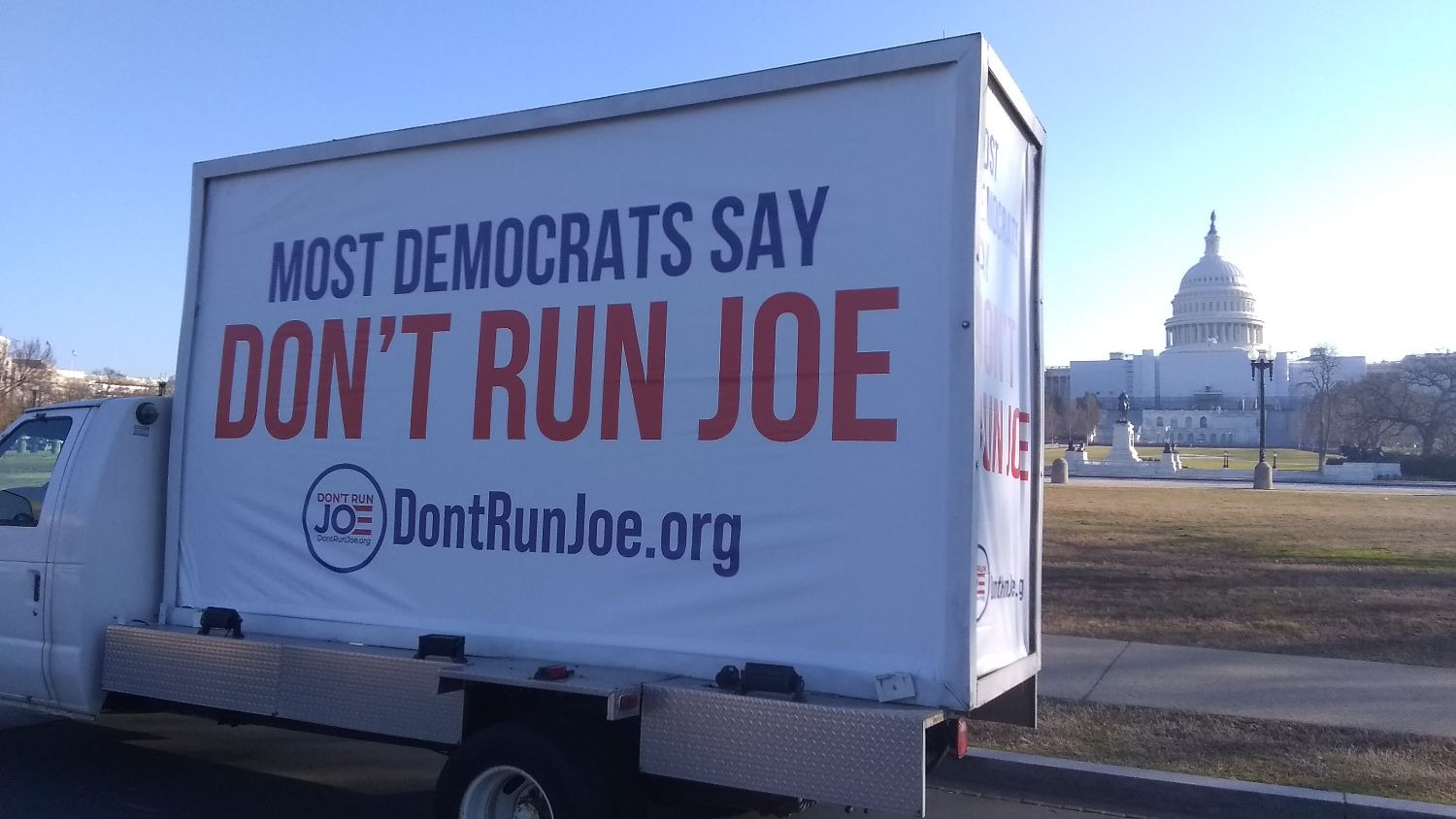
Our RootsAction.org team had no reason to avoid antagonizing the White House. Immediately after the 2022 election, we launched the Don’t Run Joe campaign. Last winter, it included TV ads in New Hampshire and other early primary states as well as in DC. We also placed full-page ads in print editions of The Hill newspaper, widely read on Capitol Hill; one depicted congressional Democrats as having their heads in the sand. A steady flow of news releases went out, citing data on Biden’s electoral vulnerabilities. A mobile Don’t Run Joe billboard circled the Capitol and White House when Congress reconvened in January.
But elected Democrats, loyal boosters and allied organizations stuck with the party line. Apparently, they couldn’t imagine being independent enough to call for a candidate who could champion a progressive agenda and be a stronger contender than the anemic Biden in the 2024 race.
Ironically, we were often told that shining a critical spotlight on Biden’s re-election chances or his corporate militarism would help Donald Trump or another Republican to win in 2024. But the opposite has been the case. Biden’s amen-corner enablers — going along to get along rather than risk disapproval from the White House — have been unwitting helpers of the upcoming GOP ticket.
The bleak poll numbers might actually understate the problem, as they measure only voter discontent and not activist discontent. For months next summer and fall, Democratic activists will be needed to win over undecided voters and mobilize occasional voters. But many activists who worked hard to elect Biden over Trump in 2020 now have little enthusiasm for the president, due to his policies on climate, racial justice, Gaza and other vital concerns.
After Biden formally filed as a candidate seven months ago, Don’t Run Joe transitioned into Step Aside Joe. The campaign has continued to be adamant that Biden should voluntarily be a one-term president.
“The truth remains that a president is not his party’s king and has no automatic right to renomination,” a statement from Step Aside Joe said in April. “Simply crowning Joe Biden as the 2024 nominee is unhealthy for the Democratic Party and the country. In the face of clear polling that shows he is ill-positioned to defeat a Republican nominee, Biden is moving the Democratic Party toward a likely disaster in 2024. As the Democratic standard bearer, Biden would represent the status quo at a time when ‘wrong track’ polling numbers are at an unprecedented high.”
But Joe Biden and his coterie of backers continue to insist that he wear a crown. The fascistic forces behind Donald Trump are surely delighted.
Norman Solomon is national director of RootsAction.org and executive director of the Institute for Public Accuracy. He is the author of many books including "War Made Easy." His latest book, "War Made Invisible: How America Hides the Human Toll of Its Military Machine," was published in summer 2023 by The New Press.
Jeff Cohen is co-founder of RootsAction.org, a retired journalism professor at Ithaca College, and author of "Cable News Confidential: My Misadventures in Corporate Media." In 1986, he founded the media watch group FAIR.
-
The Carnage in Gaza Cries Out for Repudiation and Opposition. Maybe Poetry Can Help
By Norman Solomon
Two centuries ago, Percy Shelley wrote that “poets are the unacknowledged legislators of the world.” Yet elite power has routinely vetoed their best measures. Still, the ability of poetry to inspire and nurture is precious, including when governments are on protracted killing sprees.
In Gaza, more than 11,000 civilians have been killed since early October. Children are perishing at an average rate of six deaths per hour. The ongoing slaughter by Israeli forces — supported by huge military aid from the United States — follows Hamas’s atrocities on Oct. 7 in Israel, where the latest estimate of the death toll is 1,200 including at least 846 civilians in addition to some 200 hostages.
But numbers don’t get us very far in human terms. And news accounts have limited capacities to connect with real emotions.
That’s where poetry can go far beyond where journalism fails. A few words from a poet might chip away at the frozen blocks that support illegitimate power. And we might gain strength from the clarity that a few lines can bring.
Stanley Kunitz wrote:
In a murderous time
the heart breaks and breaks
and lives by breaking.
It is necessary to go
through dark and deeper dark
and not to turn.
“In a dark time,” Theodore Roethke wrote, “the eye begins to see.”
Bob Dylan wrote lines that could now be heard as addressing Prime Minister Benjamin Netanyahu and President Biden:
You fasten all the triggers
For the others to fire
Then you sit back and watch
When the death count gets higher
You hide in your mansion
While the young people's blood
Flows out of their bodies
And is buried in the mud
June Jordan wrote:
I was born a Black woman
and now
I am become a Palestinian
against the relentless laughter of evil
there is less and less living room
and where are my loved ones?
In the United States, far away from the carnage, viewers and listeners and readers can easily prefer not to truly see that “their” government is helping Israel to keep killing thousands upon thousands of Palestinian children and other civilians. “I call it cruel and maybe the root of all cruelty / to know what occurs but not recognize the fact,” a poem by William Stafford says.
Don’t accept that what’s happening
Is just a case of others’ suffering
Or you’ll find that you’re joining in
The turning away
. . . .
Just a world that we all must share
It’s not enough just to stand and stare
Is it only a dream that there’ll be
No more turning away?
Franz Kafka wrote: “You can hold yourself back from the sufferings of the world, that is something you are free to do and it accords with your nature, but perhaps this very holding back is the one suffering you could avoid.”
_______________________
Norman Solomon is national director of RootsAction.org and executive director of the Institute for Public Accuracy. He is the author of many books including War Made Easy. His latest book, War Made Invisible: How America Hides the Human Toll of Its Military Machine, was published in summer 2023 by The New Press.
-
Israel’s Military Is Part of the U.S. War Machine
By Norman Solomon
The governments of Israel and the United States are now in disagreement over how many Palestinian civilians it’s okay to kill. Last week — as the death toll from massive Israeli bombardment of Gaza neared 10,000 people, including several thousand children — top U.S. officials began to worry about the rising horrified outcry at home and abroad. So, they went public with muted misgivings and calls for a “humanitarian pause.” But Israel’s Prime Minister Benjamin Netanyahu made clear that he would have none of it.
Such minor tactical discord does little to chip away at the solid bedrock alliance between the two countries, which are most of the way through a 10-year deal that guarantees $38 billion in U.S. military aid to Israel. And now, as the carnage in Gaza continues, Washington is rushing to provide extra military assistance worth $14 billion.
Days ago, In These Times reported that the Biden administration is seeking congressional permission “to unilaterally blanket-approve the future sale of military equipment and weapons — like ballistic missiles and artillery ammunition — to Israel without notifying Congress.” And so, “the Israeli government would be able to purchase up to $3.5 billion in military articles and services in complete secrecy.”
While Israeli forces were using weapons provided by the United States to slaughter Palestinian civilians, resupply flights were landing in Israel courtesy of U.S. taxpayers. Air & Space Forces Magazine published a photo showing “U.S. Air Force Airmen and Israeli military members unload cargo from a U.S. Air Force C-17 Globemaster III on a ramp at Nevatim Base, Israel.”
Pictures taken on Oct. 24 show that the military cargo went from Travis Air Force Base in California to Ramstein Air Base in Germany to Israel. Overall, the magazine reported, “the Air Force’s airlift fleet has been steadily working to deliver essential munitions, armored vehicles, and aid to Israel.” And so, the apartheid country is receiving a huge boost to assist with the killing.
The horrific atrocities committed by Hamas on Oct. 7 have opened the door to protracted horrific atrocities by Israel with key assistance from the United States.
Oxfam America has issued a briefing paper decrying the Pentagon’s plans to ship tens of thousands of 155mm artillery shells to the Israeli military. The organization noted that “Israel’s use of this munition in past conflicts demonstrates that its use would be virtually assured to be indiscriminate, unlawful, and devastating to civilians in Gaza.” Oxfam added: “There are no known scenarios in which 155mm artillery shells could be used in Israel’s ground operation in Gaza in compliance with international humanitarian law.”
During the last several weeks, “international humanitarian law” has been a common phrase coming from President Biden while expressing support for Israel’s military actions. It’s an Orwellian absurdity, as if saying the words is sufficient while constantly helping Israel to violate international humanitarian law in numerous ways.
“Israeli forces have used white phosphorus, a chemical that ignites when in contact with oxygen, causing horrific and severe burns, on densely populated neighborhoods,” Human Rights Watch senior legal adviser Clive Baldwin wrote in late October. “White phosphorus can burn down to the bone, and burns to 10 percent of the human body are often fatal.”
Baldwin added: “Israel has also engaged in the collective punishment of Gaza’s population through cutting off food, water, electricity, and fuel. This is a war crime, as is willfully blocking humanitarian relief from reaching civilians in need.”
At the end of last week, the Win Without War organization noted that “senior administration officials are increasingly alarmed by how the Israeli government is conducting its military operations in Gaza, as well as the reputational repercussions of the Biden administration’s support for a collective punishment strategy that clearly violates international law. Many worry that the U.S. will be blamed for the Israeli military’s indiscriminate attacks on civilians, particularly women and children.”
News reporting now tells us that Biden and Secretary of State Antony Blinken want a bit of a course correction. For them, the steady large-scale killing of Palestinian civilians became concerning when it became a PR problem.
Dressed up in an inexhaustible supply of euphemistic rhetoric and double-talk, such immoral policies are stunning to see in real time. And, for many people in Gaza, literally breathtaking.
Now, guided by political calculus, the White House is trying to persuade Israel’s prime minister to titrate the lethal doses of bombing Gaza. But as Netanyahu has made clear in recent days, Israel is going to do whatever it wants, despite pleas from its patron.
While, in effect, it largely functions in the Middle East as part of the U.S. war machine, Israel has its own agenda. Yet the two governments are locked into shared, long-term, overarching strategic interests in the Middle East that have absolutely no use for human rights except as rhetorical window-dressing. Biden made that clear last year when he fist-bumped the de facto ruler of oil-rich Saudi Arabia, a dictatorship that — with major U.S. assistance — has led an eight-year war on Yemen costing nearly 400,000 lives.
The war machine needs constant oiling from news media. That requires ongoing maintenance of the doublethink assumption that when Israel terrorizes and kills people from the air, the Israeli Defense Force is fighting “terrorism” without engaging in it.
Another helpful notion in recent weeks has been the presumption that — while Hamas puts out “propaganda” — Israel does not. And so, on Nov. 2, the PBS NewsHour’s foreign affairs correspondent Nick Schifrin reported on what he called “Hamas propaganda videos.” Fair enough. Except that it would be virtually impossible for mainstream U.S. news media to also matter-of-factly refer to public output from the Israeli government as “propaganda.” (I asked Schifrin for comment, but my several emails and texts went unanswered.)
Whatever differences might surface from time to time, the United States and Israel remain enmeshed. To the power elite in Washington, the bilateral alliance is vastly more important than the lives of Palestinian people. And it’s unlikely that the U.S. government will really confront Israel over its open-ended killing spree in Gaza.
Consider this: Just weeks before beginning her second stint as House speaker in January 2019, Rep. Nancy Pelosi was recorded on video at a forum sponsored by the Israeli American Council as she declared: “I have said to people when they ask me — if this Capitol crumbled to the ground, the one thing that would remain is our commitment to our aid, I don’t even call it aid — our cooperation — with Israel. That’s fundamental to who we are.”
Even making allowances for bizarre hyperbole, Pelosi’s statement is revealing of the kind of mentality that continues to hold sway in official Washington. It won’t change without a huge grassroots movement that refuses to go away.
Norman Solomon is the national director of RootsAction.org and executive director of the Institute for Public Accuracy. He is the author of many books including War Made Easy. His latest book, "War Made Invisible: How America Hides the Human Toll of Its Military Machine," was published in summer 2023 by The New Press.