War Made Invisible – How America Hides the Human Toll or Its Military Machine


Recent Articles:
- 30 Months After Uproar Over Jonathan Glazer’s Oscar Speech, What Do His Pro-Israel Denouncers Say Now?
- Why Ro Khanna and AOC Should Run for President in 2028
- Real History: After 9/11, the ‘War on Terror’ Was a War of Terror
- 25 Years Ago, 9/11 Triggered a U.S. Crusade of Torture
- How Hakeem Jeffries and J Street Teamed Up for Arming Genocide
-
For Media Elites, War Criminal Henry Kissinger Was a Great Man
By Norman Solomon
For U.S. mass media, Henry Kissinger’s quip that “power is the ultimate aphrodisiac” rang true. Influential reporters and pundits often expressed their love for him. The media establishment kept swooning over one of the worst war criminals in modern history.
After news of his death broke on Wednesday night, prominent coverage echoed the kind that had followed him ever since his years with President Richard Nixon, while they teamed up to oversee vast carnage in Southeast Asia.
The headline over a Washington Post news bulletin summed up: “Henry Kissinger Dies at 100. The Noted Statesman and Scholar Had Unparalleled Power Over Foreign Policy.”
But can a war criminal really be a “noted statesman”?
The New York Times top story began by describing Kissinger as a “scholar-turned-diplomat who engineered the United States’ opening to China, negotiated its exit from Vietnam, and used cunning, ambition and intellect to remake American power relationships with the Soviet Union at the time of the Cold War, sometimes trampling on democratic values to do so.”
And so, the Times spotlighted Kissinger’s role in the U.S. “exit from Vietnam” in 1973 — but not his role during the previous four years, overseeing merciless slaughter in a war that took several million lives.
“Leaving aside those who perished from disease, hunger, or lack of medical care, at least 3.8 million Vietnamese died violent war deaths according to researchers from Harvard Medical School and the University of Washington,” historian and journalist Nick Turse has noted. He added: “The best estimate we have is that 2 million of them were civilians. Using a very conservative extrapolation, this suggests that 5.3 million civilians were wounded during the war, for a total of 7.3 million Vietnamese civilian casualties overall. To such figures might be added an estimated 11.7 million Vietnamese forced from their homes and turned into refugees, up to 4.8 million sprayed with toxic herbicides like Agent Orange, an estimated 800,000 to 1.3 million war orphans, and 1 million war widows.”
All told, during his stint in government, Kissinger supervised policies that took the lives of at least 3 million people.
Henry Kissinger was the crucial U.S. official who supported the September 11, 1973 coup that brought down the democratically elected government of Salvador Allende in Chile — initiating 17 years of dictatorship, with systematic murder and torture (“trampling on democratic values” in Times-speak).
Kissinger remained as secretary of state during the presidency of Gerald Ford. Lethal machinations continued in many places, including East Timor in the Indonesian archipelago. “Under Kissinger’s direction, the U.S. gave a green light to the 1975 Indonesian invasion of East Timor (now Timor-Leste), which ushered in a 24-year brutal occupation by the Suharto dictatorship,” the human rights organization ETAN reported. “The Indonesian occupation of East Timor and West Papua was enabled by U.S. weapons and training. This illegal flow of weapons contravened congressional intent, yet Kissinger bragged about his ability to continue arms shipments to Suharto.
“These weapons were essential to the Indonesian dictator’s consolidation of military control in both East Timor and West Papua, and these occupations cost the lives of hundreds of thousands of Timorese and Papuan civilians. Kissinger’s policy toward West Papua allowed for the U.S.-based multinational corporation Freeport McMoRan to pursue its mining interests in the region, which has resulted in terrible human rights and environmental abuses; Kissinger was rewarded with a seat on the Board of Directors from 1995-2001.”
Now that’s the work of a noted statesman.
The professional love affairs between Kissinger and many American journalists endured from the time that he got a grip on the steering wheel of U.S. foreign policy when Nixon became president in early 1969. In Southeast Asia, the agenda went far beyond Vietnam.
Nixon and Kissinger routinely massacred civilians in Laos, as Fred Branfman documented in the 1972 book “Voices From the Plain of Jars.” He told me decades later: “I was shocked to the core of my being as I found myself interviewing Laotian peasants, among the most decent, human and kind people on Earth, who described living underground for years on end, while they saw countless fellow villagers and family members burned alive by napalm, suffocated by 500-pound bombs, and shredded by antipersonnel bombs dropped by my country, the United States.”
Branfman’s discoveries caused him to scrutinize U.S. policy: “I soon learned that a tiny handful of American leaders, a U.S. executive branch led by Lyndon Johnson, Richard Nixon, and Henry Kissinger, had taken it upon themselves — without even informing let alone consulting the U.S. Congress or public — to massively bomb Laos and murder tens of thousands of subsistence-level, innocent Laotian civilians who did not even know where America was, let alone commit an offense against it. The targets of U.S. bombing were almost entirely civilian villages inhabited by peasants, mainly old people and children who could not survive in the forest. The other side’s soldiers moved through the heavily forested regions in Laos and were mostly untouched by the bombing.”
The U.S. warfare in Southeast Asia was also devastating to Cambodia. Consider some words from the late Anthony Bourdain, who illuminated much about the world’s foods and cultures. As this century got underway, Bourdain wrote: “Once you’ve been to Cambodia, you’ll never stop wanting to beat Henry Kissinger to death with your bare hands. You will never again be able to open a newspaper and read about that treacherous, prevaricating, murderous scumbag sitting down for a nice chat with Charlie Rose or attending some black-tie affair for a new glossy magazine without choking. Witness what Henry did in Cambodia — the fruits of his genius for statesmanship — and you will never understand why he’s not sitting in the dock at The Hague next to [Slobodan] Milošević.”
Bourdain added that while Kissinger continued to hobnob at A-list parties, “Cambodia, the neutral nation he secretly and illegally bombed, invaded, undermined, and then threw to the dogs, is still trying to raise itself up on its one remaining leg.”
But back in the corridors of U.S. media power, Henry Kissinger never lost the sheen of brilliance.
Among the swooning journalists was ABC’s Ted Koppel, who informed viewers of the Nightline program in 1992: “If you want a clear foreign-policy vision, someone who will take you beyond the conventional wisdom of the moment, it’s hard to do any better than Henry Kissinger.” As one of the most influential broadcast journalists of the era, Koppel was not content to only declare himself “proud to be a friend of Henry Kissinger.” The renowned newsman lauded his pal as “certainly one of the two or three great secretaries of state of our century.”
Norman Solomon is national director of RootsAction.org and executive director of the Institute for Public Accuracy. He is the author of many books including "War Made Easy." His latest book, "War Made Invisible: How America Hides the Human Toll of Its Military Machine," was published in summer 2023 by The New Press.
-
Backing Biden for 2024, Conformist Democrats Have Been in Denial. Now They’re in a Panic.
By Norman Solomon and Jeff Cohen
Over the weekend, Politico published the latest in a tidal wave of stories about President Biden’s dwindling prospects for re-election. Under the headline “The Polls Keep Getting Worse for Biden,” the article pointed out that Biden is trailing the presumptive GOP nominee Donald Trump in a large majority of the latest polling.
The trend is dire, Politico reports. “The president’s standing in head-to-head matchups with Trump is falling: Among the latest surveys this month from 13 separate pollsters, Biden’s position is worse than their previous polls in all but two of them.” He continues to slip in key swing states.
The outlook is now grimmer than ever, but the big divide between Biden’s low popularity and public support for the Democratic Party overall was clear a year ago, despite the hype giving Biden credit for midterm election results in November 2022. Back then, the New York Times reported that one House Democrat offered a more candid assessment: “Biden’s numbers were ‘a huge drag’ on Democratic candidates, who won in spite of the president not thanks to him, the lawmaker said on the condition of anonymity to avoid antagonizing the White House.”
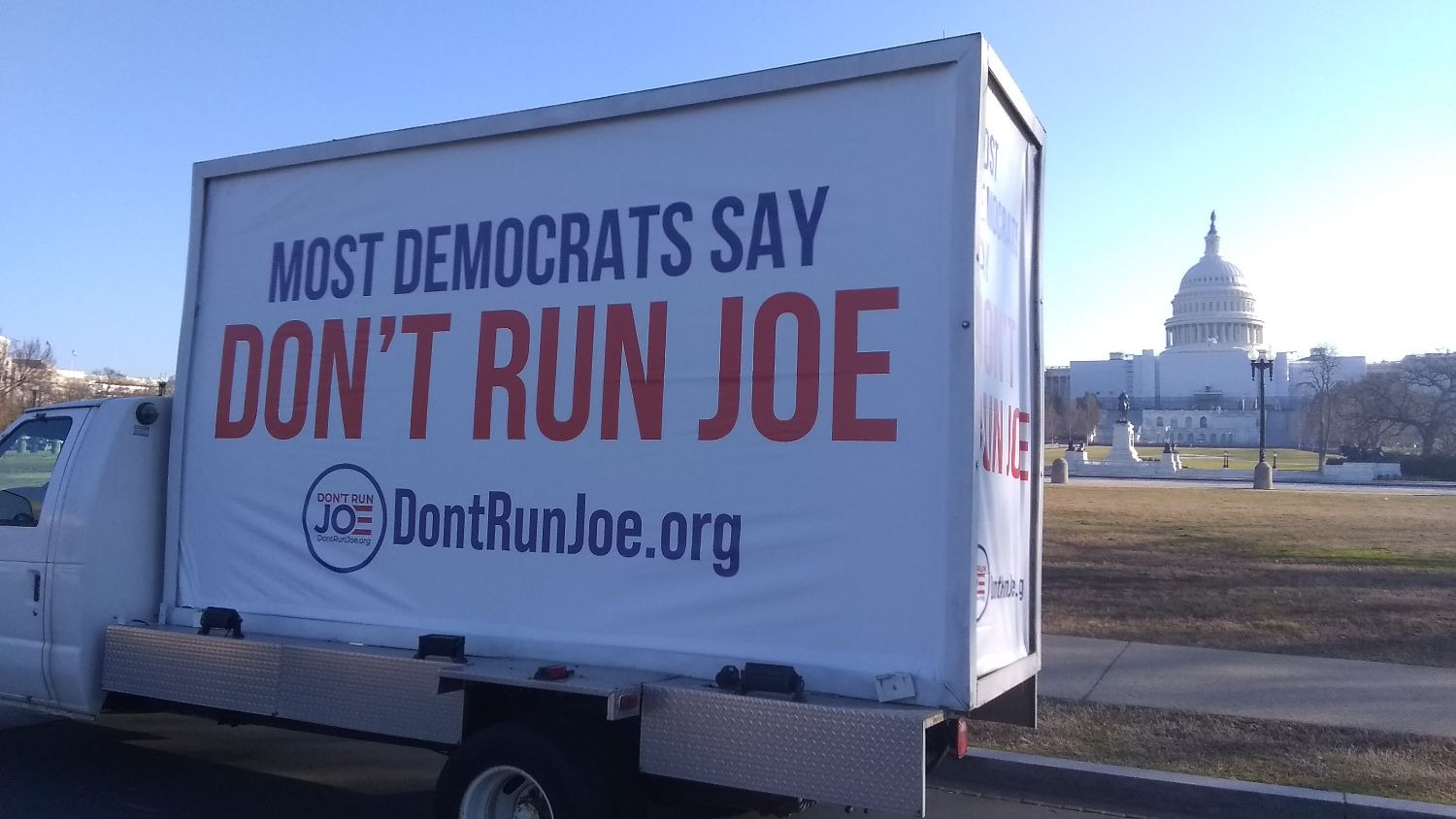
Our RootsAction.org team had no reason to avoid antagonizing the White House. Immediately after the 2022 election, we launched the Don’t Run Joe campaign. Last winter, it included TV ads in New Hampshire and other early primary states as well as in DC. We also placed full-page ads in print editions of The Hill newspaper, widely read on Capitol Hill; one depicted congressional Democrats as having their heads in the sand. A steady flow of news releases went out, citing data on Biden’s electoral vulnerabilities. A mobile Don’t Run Joe billboard circled the Capitol and White House when Congress reconvened in January.
But elected Democrats, loyal boosters and allied organizations stuck with the party line. Apparently, they couldn’t imagine being independent enough to call for a candidate who could champion a progressive agenda and be a stronger contender than the anemic Biden in the 2024 race.
Ironically, we were often told that shining a critical spotlight on Biden’s re-election chances or his corporate militarism would help Donald Trump or another Republican to win in 2024. But the opposite has been the case. Biden’s amen-corner enablers — going along to get along rather than risk disapproval from the White House — have been unwitting helpers of the upcoming GOP ticket.
The bleak poll numbers might actually understate the problem, as they measure only voter discontent and not activist discontent. For months next summer and fall, Democratic activists will be needed to win over undecided voters and mobilize occasional voters. But many activists who worked hard to elect Biden over Trump in 2020 now have little enthusiasm for the president, due to his policies on climate, racial justice, Gaza and other vital concerns.
After Biden formally filed as a candidate seven months ago, Don’t Run Joe transitioned into Step Aside Joe. The campaign has continued to be adamant that Biden should voluntarily be a one-term president.
“The truth remains that a president is not his party’s king and has no automatic right to renomination,” a statement from Step Aside Joe said in April. “Simply crowning Joe Biden as the 2024 nominee is unhealthy for the Democratic Party and the country. In the face of clear polling that shows he is ill-positioned to defeat a Republican nominee, Biden is moving the Democratic Party toward a likely disaster in 2024. As the Democratic standard bearer, Biden would represent the status quo at a time when ‘wrong track’ polling numbers are at an unprecedented high.”
But Joe Biden and his coterie of backers continue to insist that he wear a crown. The fascistic forces behind Donald Trump are surely delighted.
Norman Solomon is national director of RootsAction.org and executive director of the Institute for Public Accuracy. He is the author of many books including "War Made Easy." His latest book, "War Made Invisible: How America Hides the Human Toll of Its Military Machine," was published in summer 2023 by The New Press.
Jeff Cohen is co-founder of RootsAction.org, a retired journalism professor at Ithaca College, and author of "Cable News Confidential: My Misadventures in Corporate Media." In 1986, he founded the media watch group FAIR.
-
The Carnage in Gaza Cries Out for Repudiation and Opposition. Maybe Poetry Can Help
By Norman Solomon
Two centuries ago, Percy Shelley wrote that “poets are the unacknowledged legislators of the world.” Yet elite power has routinely vetoed their best measures. Still, the ability of poetry to inspire and nurture is precious, including when governments are on protracted killing sprees.
In Gaza, more than 11,000 civilians have been killed since early October. Children are perishing at an average rate of six deaths per hour. The ongoing slaughter by Israeli forces — supported by huge military aid from the United States — follows Hamas’s atrocities on Oct. 7 in Israel, where the latest estimate of the death toll is 1,200 including at least 846 civilians in addition to some 200 hostages.
But numbers don’t get us very far in human terms. And news accounts have limited capacities to connect with real emotions.
That’s where poetry can go far beyond where journalism fails. A few words from a poet might chip away at the frozen blocks that support illegitimate power. And we might gain strength from the clarity that a few lines can bring.
Stanley Kunitz wrote:
In a murderous time
the heart breaks and breaks
and lives by breaking.
It is necessary to go
through dark and deeper dark
and not to turn.
“In a dark time,” Theodore Roethke wrote, “the eye begins to see.”
Bob Dylan wrote lines that could now be heard as addressing Prime Minister Benjamin Netanyahu and President Biden:
You fasten all the triggers
For the others to fire
Then you sit back and watch
When the death count gets higher
You hide in your mansion
While the young people's blood
Flows out of their bodies
And is buried in the mud
June Jordan wrote:
I was born a Black woman
and now
I am become a Palestinian
against the relentless laughter of evil
there is less and less living room
and where are my loved ones?
In the United States, far away from the carnage, viewers and listeners and readers can easily prefer not to truly see that “their” government is helping Israel to keep killing thousands upon thousands of Palestinian children and other civilians. “I call it cruel and maybe the root of all cruelty / to know what occurs but not recognize the fact,” a poem by William Stafford says.
Don’t accept that what’s happening
Is just a case of others’ suffering
Or you’ll find that you’re joining in
The turning away
. . . .
Just a world that we all must share
It’s not enough just to stand and stare
Is it only a dream that there’ll be
No more turning away?
Franz Kafka wrote: “You can hold yourself back from the sufferings of the world, that is something you are free to do and it accords with your nature, but perhaps this very holding back is the one suffering you could avoid.”
_______________________
Norman Solomon is national director of RootsAction.org and executive director of the Institute for Public Accuracy. He is the author of many books including War Made Easy. His latest book, War Made Invisible: How America Hides the Human Toll of Its Military Machine, was published in summer 2023 by The New Press.
-
Israel’s Military Is Part of the U.S. War Machine
By Norman Solomon
The governments of Israel and the United States are now in disagreement over how many Palestinian civilians it’s okay to kill. Last week — as the death toll from massive Israeli bombardment of Gaza neared 10,000 people, including several thousand children — top U.S. officials began to worry about the rising horrified outcry at home and abroad. So, they went public with muted misgivings and calls for a “humanitarian pause.” But Israel’s Prime Minister Benjamin Netanyahu made clear that he would have none of it.
Such minor tactical discord does little to chip away at the solid bedrock alliance between the two countries, which are most of the way through a 10-year deal that guarantees $38 billion in U.S. military aid to Israel. And now, as the carnage in Gaza continues, Washington is rushing to provide extra military assistance worth $14 billion.
Days ago, In These Times reported that the Biden administration is seeking congressional permission “to unilaterally blanket-approve the future sale of military equipment and weapons — like ballistic missiles and artillery ammunition — to Israel without notifying Congress.” And so, “the Israeli government would be able to purchase up to $3.5 billion in military articles and services in complete secrecy.”
While Israeli forces were using weapons provided by the United States to slaughter Palestinian civilians, resupply flights were landing in Israel courtesy of U.S. taxpayers. Air & Space Forces Magazine published a photo showing “U.S. Air Force Airmen and Israeli military members unload cargo from a U.S. Air Force C-17 Globemaster III on a ramp at Nevatim Base, Israel.”
Pictures taken on Oct. 24 show that the military cargo went from Travis Air Force Base in California to Ramstein Air Base in Germany to Israel. Overall, the magazine reported, “the Air Force’s airlift fleet has been steadily working to deliver essential munitions, armored vehicles, and aid to Israel.” And so, the apartheid country is receiving a huge boost to assist with the killing.
The horrific atrocities committed by Hamas on Oct. 7 have opened the door to protracted horrific atrocities by Israel with key assistance from the United States.
Oxfam America has issued a briefing paper decrying the Pentagon’s plans to ship tens of thousands of 155mm artillery shells to the Israeli military. The organization noted that “Israel’s use of this munition in past conflicts demonstrates that its use would be virtually assured to be indiscriminate, unlawful, and devastating to civilians in Gaza.” Oxfam added: “There are no known scenarios in which 155mm artillery shells could be used in Israel’s ground operation in Gaza in compliance with international humanitarian law.”
During the last several weeks, “international humanitarian law” has been a common phrase coming from President Biden while expressing support for Israel’s military actions. It’s an Orwellian absurdity, as if saying the words is sufficient while constantly helping Israel to violate international humanitarian law in numerous ways.
“Israeli forces have used white phosphorus, a chemical that ignites when in contact with oxygen, causing horrific and severe burns, on densely populated neighborhoods,” Human Rights Watch senior legal adviser Clive Baldwin wrote in late October. “White phosphorus can burn down to the bone, and burns to 10 percent of the human body are often fatal.”
Baldwin added: “Israel has also engaged in the collective punishment of Gaza’s population through cutting off food, water, electricity, and fuel. This is a war crime, as is willfully blocking humanitarian relief from reaching civilians in need.”
At the end of last week, the Win Without War organization noted that “senior administration officials are increasingly alarmed by how the Israeli government is conducting its military operations in Gaza, as well as the reputational repercussions of the Biden administration’s support for a collective punishment strategy that clearly violates international law. Many worry that the U.S. will be blamed for the Israeli military’s indiscriminate attacks on civilians, particularly women and children.”
News reporting now tells us that Biden and Secretary of State Antony Blinken want a bit of a course correction. For them, the steady large-scale killing of Palestinian civilians became concerning when it became a PR problem.
Dressed up in an inexhaustible supply of euphemistic rhetoric and double-talk, such immoral policies are stunning to see in real time. And, for many people in Gaza, literally breathtaking.
Now, guided by political calculus, the White House is trying to persuade Israel’s prime minister to titrate the lethal doses of bombing Gaza. But as Netanyahu has made clear in recent days, Israel is going to do whatever it wants, despite pleas from its patron.
While, in effect, it largely functions in the Middle East as part of the U.S. war machine, Israel has its own agenda. Yet the two governments are locked into shared, long-term, overarching strategic interests in the Middle East that have absolutely no use for human rights except as rhetorical window-dressing. Biden made that clear last year when he fist-bumped the de facto ruler of oil-rich Saudi Arabia, a dictatorship that — with major U.S. assistance — has led an eight-year war on Yemen costing nearly 400,000 lives.
The war machine needs constant oiling from news media. That requires ongoing maintenance of the doublethink assumption that when Israel terrorizes and kills people from the air, the Israeli Defense Force is fighting “terrorism” without engaging in it.
Another helpful notion in recent weeks has been the presumption that — while Hamas puts out “propaganda” — Israel does not. And so, on Nov. 2, the PBS NewsHour’s foreign affairs correspondent Nick Schifrin reported on what he called “Hamas propaganda videos.” Fair enough. Except that it would be virtually impossible for mainstream U.S. news media to also matter-of-factly refer to public output from the Israeli government as “propaganda.” (I asked Schifrin for comment, but my several emails and texts went unanswered.)
Whatever differences might surface from time to time, the United States and Israel remain enmeshed. To the power elite in Washington, the bilateral alliance is vastly more important than the lives of Palestinian people. And it’s unlikely that the U.S. government will really confront Israel over its open-ended killing spree in Gaza.
Consider this: Just weeks before beginning her second stint as House speaker in January 2019, Rep. Nancy Pelosi was recorded on video at a forum sponsored by the Israeli American Council as she declared: “I have said to people when they ask me — if this Capitol crumbled to the ground, the one thing that would remain is our commitment to our aid, I don’t even call it aid — our cooperation — with Israel. That’s fundamental to who we are.”
Even making allowances for bizarre hyperbole, Pelosi’s statement is revealing of the kind of mentality that continues to hold sway in official Washington. It won’t change without a huge grassroots movement that refuses to go away.
Norman Solomon is the national director of RootsAction.org and executive director of the Institute for Public Accuracy. He is the author of many books including War Made Easy. His latest book, "War Made Invisible: How America Hides the Human Toll of Its Military Machine," was published in summer 2023 by The New Press.
-
Biden Is a Genocide Denier and the “Enabler in Chief” for Israel’s Ongoing War Crimes
By Norman Solomon
For three weeks, President Biden has played a key role in backing Israel’s war crimes while touting himself as a compassionate advocate of restraint. That pretense is lethal nonsense as Israel persists with mass killing of civilians in Gaza.
The same crucial standards that fully condemned Hamas’s murders of Israeli civilians on Oct. 7 should apply to Israel’s ongoing murders that have already taken the lives of at least several times as many Palestinian civilians. And Israel is just getting started.
“We need an immediate ceasefire,” Congresswoman Rashida Tlaib wrote in an email Saturday evening, “but the White House and Congress continue to unconditionally support the Israeli government’s genocidal actions.”
That unconditional support makes Biden and the vast majority of Congress directly complicit with mass murder and genocide, defined as “the deliberate killing of a large number of people from a particular nation or ethnic group with the aim of destroying that nation or group.” The definition clearly fits the words and deeds of Israel’s leaders.
“Israel has dropped approximately 12,000 tons of explosives on Gaza so far and has reportedly killed multiple senior Hamas commanders, but the majority of the casualties have been women and children,” Time magazine summed up at the end of last week. Israel’s military has been shamelessly slaughtering civilians in homes, stores, markets, mosques, refugee camps and healthcare facilities. Imagine what can be expected now that communications between Gaza and the outside world are even less possible.
For reporters, being on the ground in Gaza is very dangerous; Israel’s assault has already killed at least 29 journalists. For the Israeli government, the fewer journalists alive in Gaza the better; media reliance on Israeli handouts, news conferences and interviews is ideal.
Pro-Israel frames of reference and word choices are routine in U.S. mainstream media. Yet some exceptional reporting has shed light on the merciless cruelty of Israel’s actions in Gaza, where 2.2 million people live.
For example, on Oct. 28, PBS News Weekend provided a human reality check as Israel began a ground assault while stepping up its bombing of Gaza. “As Israeli ground operations intensified there, suddenly the phone and internet signal went out,” correspondent Leila Molana-Allen reported. “So, people in Gaza, voiceless through the night as they were under these intense bombardments. People were unable to call ambulances, and we’ve heard this morning that ambulance drivers were standing at high points throughout, trying to see where the explosions were, so they could just drive directly there. People unable to communicate with their families to see if they’re alright. People this morning saying ‘we’ve been digging children out of the rubble with our bare hands because we can’t call for help.’”
While people in Gaza “are under some of the most intense bombardment we’ve ever seen,” Molana-Allen added, they have no safe place to go: “Even though they’re still being told to move to the south, in fact most people can’t get to the south because they have no fuel for their cars, they can’t travel, and even in the south bombardment continues.”
Meanwhile, Biden has continued to publicly express his unequivocal support for what Israel is doing. After he spoke with Israeli Prime Minister Benjamin Netanyahu last week, the White House issued a statement without the slightest mention of concern about what Israel’s bombing was inflicting on civilians. Instead, the statement said, “the President reiterated that Israel has every right and responsibility to defend its citizens from terrorism and to do so in a manner consistent with international humanitarian law.”
Biden’s support for continuing the carnage in Gaza is matched by Congress. As Israel began its fourth week of terrorizing and killing, only 18 members of the House were on the list of lawmakers cosponsoring H.Res. 786, “Calling for an immediate de-escalation and cease-fire in Israel and occupied Palestine.” All of those 18 cosponsors are people of color.
While Israel kills large numbers of Palestinian civilians each day — and clearly intends to kill many thousands more — we can see “progressive” masks falling away from numerous members of Congress who remain cravenly frozen in political conformity.
“In a dark time,” poet Theodore Roethke wrote, “the eye begins to see.”
Norman Solomon is the national director of RootsAction.org and executive director of the Institute for Public Accuracy. He is the author of many books including "War Made Easy." His latest book, "War Made Invisible: How America Hides the Human Toll of Its Military Machine," was published in summer 2023 by The New Press.
-
Hamas Is a Terrorist Organization. So Is the Israeli Government.
By Norman Solomon
Labels are central to the politics of media. And no label has been more powerful than “terrorist.”
A single standard of language should accompany a consistent standard of human rights, which the world desperately needs. “If thought corrupts language,” George Orwell wrote, “language can also corrupt thought. A bad usage can spread by tradition and imitation, even among people who should and do know better.”
No amount of rhetoric from its defenders and apologists can change the reality that Hamas engaged in mass murder. What Hamas horrifically did to more than 1,000 Israeli civilians of all ages two weeks ago meets the dictionary definition of terrorism.
And no amount of rhetoric can change the reality that the Israeli government has engaged in mass murder during the last two weeks. What Israel’s military is horrifically doing in Gaza, already killing several thousand Palestinian civilians of all ages, also meets the definition of terrorism.
But U.S. media outlets dodge being evenhanded with the “terrorist” label — applying it to organized Palestinian killers of Israelis and not to organized Israeli killers of Palestinians.
The routine media bias does not in any way mitigate the horrendous crimes committed by Hamas in Israel. And that media bias does not in any way mitigate the horrendous crimes that are being committed — on an even larger scale, increasing daily — by the Israeli government in Gaza.
By any consistent standard, if referring to Hamas as a terrorist organization, then the same description fits the Israeli government. But such balanced candor is absolutely intolerable in the mainstream media and politics of the United States. It would be too honest. Too real.
Terrorists and their defenders always have excuses when tactics include ruthlessly killing civilians. But we’re choking on a nonstop supply of smoke-blowing rhetoric — what Orwell called political language “designed to make lies sound truthful and murder respectable.”
Some have contended that the word “terrorist” should be excluded from news accounts because it can be subjective. Although ignored or derided soon after 9/11, Reuters news service explained its policy this way: “Throughout this difficult time we have strictly adhered to our 150-year-old tradition of factual, unbiased reporting and upheld our long-standing policy against the use of emotive terms, including the words ‘terrorist’ or ‘freedom fighter.’ We do not characterize the subjects of news stories but instead report their actions, identity or background.”
But that media stance is an outlier. We seem to be stuck with the “terrorist” word. Ending the routinely slanted, selective use of the “t” word would be a real improvement; more realistically, we should recognize and reject its flagrantly skewed usage. It functions in sync with an array of tilted reporting patterns.
Since the latest Israeli assault on Gaza began, U.S. news outlets have constantly used euphemistic words like “strike,” “hammer,” “pressure” and “retaliate” to blur the real meaning of what it has meant to human beings when a very densely populated area is attacked with thousands of large bombs. Vivid reporting has occurred at times, but the overwhelming bulk of coverage of the Israeli government’s wide-ranging terrorism has been abstracted in ways that coverage of the Hamas terrorism has not been.
One factor that makes the blurring easier: The Hamas atrocities were mostly up close, with the murderers and murdered often facing each other, whereas the Israeli atrocities have been committed from high in the air, as if above it all. While international media outlets like Al Jazeera English and the U.S.-based program Democracy Now! have consistently provided extraordinary, high-quality, heart-rending reportage about the carnage and terror in Gaza as well as in Israel, such humanely equitable reporting has been extremely rare in mainline U.S. media outlets.
Americans have been acculturated to assume, consciously or not, that killing people with high-tech weaponry from the air is a civilized way to go about the business of war, if the U.S. or its allies are doing it, in sharp contrast to low-tech efforts of adversaries. This is an outlook from a privileged vantage point, far from those on the receiving end of “sophisticated” firepower coming from, or backed by, the U.S. government.
Apologists for Israel point out that Hamas targets civilians and Israel does not. That is a distinction without a difference for the people killed, maimed and terrorized by the Israeli military — commanded by leaders who know damn well that Palestinian civilians will be massacred. The cover story of not “targeting” civilians is a comfortable rationalization for the slaughter of civilians while righteously denying the reality.
Overall — given the extreme pro-Israel, anti-Palestinian spin of U.S. mass media — evenhanded use of the “terrorist” label is highly unlikely. But we should strive to challenge the biases at work and the deadly consequences.
Norman Solomon is national director of RootsAction.org and executive director of the Institute for Public Accuracy. He is the author of many books including "War Made Easy." His latest book, "War Made Invisible: How America Hides the Human Toll of Its Military Machine," was published in summer 2023 by The New Press.
-
“Israel’s 9/11” Is a Slogan to Rationalize Open-Ended Killing of Palestinian Civilians
By Norman Solomon
When Israel’s ambassador to the United Nations spoke outside the Security Council on Sunday, he said: “This is Israel’s 9/11. This is Israel’s 9/11.” Meanwhile, in a PBS NewsHour interview, Israel’s ambassador to the United States said: “This is, as someone said, our 9/11.”
While the phrase might seem logical, “Israel’s 9/11” is already being used as a huge propaganda weapon by Israel’s government — now engaged in massive war crimes against civilians in Gaza, after mass murder of Israelis by Hamas last weekend.
On the surface, an analogy between the atrocities just suffered by Israelis and what happened on Sept. 11, 2001 might seem to justify calls for unequivocal solidarity with Israel. But horrific actions are in process from an Israeli government that has long maintained a system of apartheid while crushing basic human rights of Palestinian people.
What is very sinister about trumpeting “Israel’s 9/11” is what happened after America’s 9/11. Wearing the shroud of victim, the United States proceeded to use the horrible tragedy suffered inside its own borders as a license to kill vast numbers of people in the name of retaliation, righteousness and, of course, the “war on terror.”
It’s a playbook that the government of Benjamin Netanyahu is currently adapting and implementing with a vengeance. Now underway, Israel’s collective punishment of 2.3 million people in Gaza is an intensification of what Israel has been doing to Palestinians for decades. But Israel’s extremism, more than ever touting itself as a matter of self-defense, is at new racist depths of willingness to treat human beings as suitable for extermination.
On Monday, Israel’s Defense Minister Yoav Gallant described Palestinians as “beastly people” and said: “We are fighting animals and are acting accordingly.”
Indiscriminate bombing is now happening along with a cutoff of food, water, electricity and fuel. Noting that “even before the latest restrictions, residents of Gaza already faced widespread food insecurity, restrictions on movement and water shortages,” the BBC reported that a UN official said people in Gaza “were ‘terrified’ by the current situation and worried for their safety — as well as that of their children and families.”
This is a terrible echo from the post-9/11 approach of the U.S. government, which from the outset after Sept. 11, 2001 conferred advance absolution on itself for any and all of its future crimes against humanity.
In the name of fighting terrorism, the United States inflicted collective punishment on huge numbers of people who had absolutely nothing to do with 9/11. The Costs of War project at Brown University calculates more than 400,000 direct civilian deaths “in the violence of the U.S. post-9/11 wars in Afghanistan, Pakistan, Iraq, Syria, Yemen and elsewhere.”
Early in the “war on terror,” Defense Secretary Donald Rumsfeld had fashioned a template to provide approval for virtually any killing by the U.S. military. “We did not start this war,” he said at a news briefing in December 2001, two months into the Afghanistan war. “So understand, responsibility for every single casualty in this war, whether they’re innocent Afghans or innocent Americans, rests at the feet of the al Qaeda and the Taliban.”
Rumsfeld was showered with acclaim from the U.S. media establishment, while he not only insisted that the U.S. government had no responsibility for the deaths caused by its armed forces; he also attested to the American military’s notable decency. “The targeting capabilities, and the care that goes into targeting, to see that the precise targets are struck, and that other targets are not struck, is as impressive as anything anyone could see,” Rumsfeld said. He lauded “the care that goes into it, the humanity that goes into it.”
Even before its current high-tech attack on Gaza, Israel had amassed a long track record of killing civilians there, while denying it every step of the way. For instance, the United Nations found that during Israel’s 2014 “Operation Protective Edge” assault, 1,462 Palestinian civilians died, including 495 children.
There’s no reason to doubt that the civilian death toll from the present Israeli military actions in Gaza will soon climb far above the number of people killed by the Hamas assault days ago. As in the aftermath of 9/11, official claims to be only fighting terrorism will continue to serve as PR smokescreens for a government terrorizing and inflicting mass carnage on Palestinians. Deserving only unequivocal condemnation, Hamas’s killing and abduction of civilians set the stage for Israel’s slaughter of civilians now underway in Gaza.
Absent from the New York Times home page Monday night and relegated to page 9 of the newspaper’s print edition on Tuesday, a grisly news story began this way: “Israeli airstrikes pounded Gaza on Monday, flattening mosques over the heads of worshipers, wiping away a busy marketplace full of shoppers and killing entire families, witnesses and authorities in Gaza said. Five Israeli airstrikes ripped through the marketplace in the Jabaliya refugee camp, reducing it to rubble and killing dozens, the authorities said. Other strikes hit four mosques in the Shati refugee camp and killed people worshiping inside, they said. Witnesses said boys had been playing soccer outside one of the mosques when it was struck.”
Along with releasing a statement about the latest tragic turn of events, at RootsAction.org we’ve offered supporters of a just peace a quick way to email their members of Congress and President Biden. The gist of the message is that “the horrific cycle of violence in the Middle East will not end until the Israeli occupation ends — and a huge obstacle to ending the occupation has been the U.S. government.”
Norman Solomon is national director of RootsAction.org and executive director of the Institute for Public Accuracy. He is the author of many books including "War Made Easy." His latest book, "War Made Invisible: How America Hides the Human Toll of Its Military Machine," was published in summer 2023 by The New Press.
-
As RFK Jr. Shifts His 2024 Strategy, He’s Bad News for Progressives
By Jeff Cohen and Norman Solomon
If Robert F. Kennedy Jr. follows through on his apparent plans to run for president in the fall 2024 general election, that will make it all the more important for progressives to have a clear understanding of who Kennedy is and what he really stands for.
In advance of announcing that he’ll run as an independent, according to Mediaite, the Kennedy campaign will deploy “attack ads” against the Democratic National Committee for preventing an open primary process. The DNC’s shenanigans deserve to be condemned, and we’ve repeatedly done so, including here, here and here.
Kennedy can be forceful in denouncing aspects of U.S. militarism – making valid points about hawkish foreign policies that shun diplomacy while enriching military contractors. But a closer look at his overall views is needed, lest progressives follow Kennedy into his often inaccurate – and sometimes demagogic – rabbit hole.
Any serious progressive critique of U.S. foreign policy must include a challenge to our country’s one-sided position on Israel/Palestine – which leads to other dangerous policies, such as supporting the Saudi dictatorship (and its horrific Yemen war), while eternally polarizing with and threatening Iran.
Kennedy seems to believe that Washington has not been one-sided enough in support of Israel. He pledged in a mid-July interview: “There’s nobody who’s running for president right now in either party who will be a better friend to Israel than me as president.” Kennedy followed up by saying: “Progressive Democrats have become outspoken opponents of Israel. That’s the worst outcome of woke culture.”
And he added: “The criticism of Israel is a false narrative. Israel is a shining star on human rights in the Middle East.”
If you are a progressive who is leaning toward RFK Jr. but cares about Palestinian rights and Middle East peace, you should watch the recent interview with him conducted by Israel-can-do-no-wrong Rabbi Shmuley Boteach. Kennedy questions the “narrative” of Palestinians as “oppressed,” applauds the Israeli military for consistently “avoiding civilian casualties,” says he doesn't want the Biden administration to make a nuclear agreement with Iran, and agrees with Rabbi Shmuley’s characterization of Congresswomen Ilhan Omar and Rashida Tlaib as “anti-Semitic.”
In that July 16 interview, RFK Jr. was evidently trying to do damage control after the discovery of a video from this summer in which he made bizarre comments suggesting that Covid-19 was an “ethnically targeted” bioweapon and that Ashkenazi Jews and Chinese people are the most immune. But Kennedy’s extreme support of Israel and his closeness with Rabbi Shmuley predate those comments. In June, he waved Israeli flags side-by-side with Shmuley in Manhattan’s “Celebrate Israel 75th” parade and declared in a column for Jewish Journal: “I support Israel because I share Israel’s values.”
Kennedy’s positions on domestic policies – from the climate crisis to economics to his extreme anti-vaccination views – are often at odds with progressivism. In a thorough critique, Naomi Klein exposes his faux populism and support from high-tech billionaires. Besides debunking many of his claims about vaccines, Klein points out that Kennedy asserts the climate crisis is being overhyped by “totalitarian elements in our society” and has said that he’d leave energy policy to market forces.
Klein makes clear that RFK Jr. is no economic populist: “On Fox, he would not even come out in favor of a wealth tax; he has brushed off universal public health care as not ‘politically realistic’; and I have heard nothing about raising the minimum wage.”
Kennedy does not have a systemic, class analysis of what’s wrong in U.S. society. Instead, he has a conspiratorial view. And through his use of social media and other outreach, he’s attracted considerable support from the conspiracy-minded right wing. In April, Steve Bannon – seen as the brains behind Donald Trump – commented that “Bobby Kennedy would be an excellent choice for Trump to consider” as a VP running-mate. Both Florida Gov. Ron DeSantis and Trump acolyte Roger Stone said in late July that it might be good to put Kennedy in the next Republican cabinet.
While running for president as a Democrat, RFK Jr. gave friendly interviews to corporate libertarian outlets. That coziness and his consultation with the chair of the Libertarian Party have led to speculation that he’ll end up as the candidate of the Libertarians, whose party was on the ballot in almost every state in 2020. (Going it alone, RFK Jr. would likely not qualify for many state ballots, given the undemocratic hurdles.)
It’s unclear what RFK Jr.’s strategy is. What is clear is that his campaign may end up helping the neo-fascist Republicans win in November 2024. Back in 2016, Trump narrowly defeated Hillary Clinton after both major parties nominated very unpopular candidates. Eight percent of young voters – a demographic that leans heavily Democratic – voted for either the Libertarian or Green parties, a percentage that was much higher in some swing states.
Robert F. Kennedy Jr. offers progressives a mishmash of appealing statements, “free market” corporatism and assorted political toxins. Not a good deal.
Jeff Cohen is co-founder of RootsAction.org, a retired journalism professor at Ithaca College, and author of "Cable News Confidential: My Misadventures in Corporate Media." In 1986, he founded the media watch group FAIR.
Norman Solomon is national director of RootsAction.org and executive director of the Institute for Public Accuracy. He is the author of many books including "War Made Easy." His latest book, "War Made Invisible: How America Hides the Human Toll of Its Military Machine," was published in summer 2023 by The New Press.
-
Elected Democrats Are Conformist Enablers of Biden for 2024
By Norman Solomon
Recent news reports have been filled with results of one poll after another after another showing that President Biden continues to weaken as a candidate for re-election. With an overall approval rating now 21 points underwater, polling shows he has lost support among key demographics that made his 2020 victory possible – especially the young and people of color. Alarm bells among pro-Biden pundits have finally begun to break the political sound barrier.
But on Capitol Hill, all’s quiet on the Democratic front.
A gap has grown vast between current assessments from media, largely based on voter opinion data, and current public claims from congressional Democrats who keep their nose to the talking-points grindstone. An effect is that party leaders and backbenchers alike are losing credibility with the party’s base.
The gap is so lopsided that a poll this month found 67 percent of “Democrats and Democratic-leaning independent voters” said they don’t want Biden to run again. Meanwhile, no more than 1 percent of Democrats in Congress are willing to say so in public. By any measure, a disconnect between 67 and 1 percent is, uh, substantial.
For Democratic lawmakers to be so untethered from the people who elected them tells you a lot about the compliant relationship that usually prevails among elected Democrats toward President Biden. And it signifies an unhealthy relationship between Democrats in office and the party’s activist base.
While supposedly representing a progressive grassroots base to the political establishment, some members of Congress end up routinely representing the political establishment to the progressive grassroots base.
The dire need for progressive advances in government policies is undermined when elected Democrats reflexively echo the Biden 2024 campaign line and pretend that he’s a sufficiently strong candidate to defeat the neofascist Republican Party next year. When deferring to congressional Democrats who in turn defer to the man in the Oval Office, progressive activists and organizations end up functioning more like supplicants than constituents in a representative democracy.
Top Democrats and their allies have publicly touted the canard that cast Joe Biden as a hero of last year’s midterms. The intoxication from that messaging was in sharp contrast to the sober clarity from a re-elected House Democrat who spoke to the New York Times “on the condition of anonymity to avoid antagonizing the White House.” The newspaper reported that the congressmember said “Biden’s numbers were ‘a huge drag’ on Democratic candidates, who won in spite of the president not thanks to him.”
Polling in the 10 months since then indicates that Biden would likely be an even huger drag on Democratic candidates a year from now. But hope springs eternal, and so does fear of angering the White House. With the start of presidential primaries just a few months away, the crux of the matter is that Democrats in Congress are opting for self-focused, risk-averse conformity rather than visionary leadership.
Now — while even pro-Biden media like CNN and MSNBC are, at last, sounding more realistic about Biden’s severe electoral deficits — prominent Democrats are either keeping quiet about the grim odds of a 2024 political train wreck or are spouting feel-good nonsense worthy of the myopic Mr. Magoo. The more that Democrats in the House and Senate declare how great Biden will be as the party’s standard-bearer next year, the more it seems they’ve been swallowed up by a Capitol Hill bubble.
Yet mainstream media outlets are now underscoring the wide distance between the Democratic players on the Hill and the Democratic voters who’ve put them there. NBC News brought it all into focus, summing up: “When party elites look at President Joe Biden, they see the second coming of Franklin D. Roosevelt. When voters view the president, many see an old man.”
More importantly, many hear timeworn ideas and promises that ring hollow. Working-class voters can see and hear a president who has refused to really fight for their economic interests, while corporate greed has been raising prices. It’s an invitation to eye-rolling from core Democratic constituencies when Biden and his advocates proclaim how he’s going to go all-out to fight for their interests in the second term after he hasn’t done so in the first.
To Democratic officeholders, worried about retaining the presidency and their own seats, such matters might seem relatively unimportant. But bleak electoral consequences are foreseeable. Biden has declined to use the bully pulpit to battle for progressive measures that are poll-tested and popular with the electorate.
Democrats in Congress have ample reasons to be apprehensive about next year. But their silences and spin increasingly make them look more like PR specialists than leaders. The more they prop up Joe Biden to run for re-election, the better Donald Trump likes the odds he’ll return to the White House.
Norman Solomon is the national director of RootsAction.org and executive director of the Institute for Public Accuracy. He is the author of many books including "War Made Easy." His latest book, "War Made Invisible: How America Hides the Human Toll of Its Military Machine," was published in summer 2023 by The New Press.
-
For the New York Times, Cluster Munitions Are Completely Wrong—When Russians Use Them
By Norman Solomon / FAIR.org
For the New York Times news department, cluster munitions fall into two categories—clearly wrong or complexly controversial—depending on who uses them.
There was no ambiguity when Russia apparently started using cluster weapons during the invasion of Ukraine. Five days after the invasion began, the Times (3/1/22) front-paged a story that described them in the second paragraph as “internationally banned” and went on to report: "Neither Russia nor Ukraine is a member of the treaty that bans cluster munitions, which can be a variety of weapons—rockets, bombs, missiles and artillery projectiles—that disperse lethal bomblets in midair over a wide area, hitting military targets and civilians alike."
Given that the Times is a US-based outlet, the long article unduly detoured around some basic facts—notably, that the United States is also not “a member of the treaty that bans cluster munitions.” And the 1,570-word piece failed to mention anything about the US military’s firing of cluster munitions during its own invasions and other military interventions, including Yugoslavia in 1999, Afghanistan in 2001 and Iraq in 2003. The Congressional Research Service has noted that “US and British forces used almost 13,000 cluster munitions containing an estimated 1.8 to 2 million submunitions during the first three weeks of combat in Iraq in 2003.”
When the Times (3/5/22) followed up a few days later with a piece headlined “NATO Accuses Russia of Using Cluster Bombs in Ukraine,” the ostensible paper of record still did not mention Washington’s refusal to sign the treaty banning cluster munitions. As for US use of those weapons, the piece buried a single sentence with a deficient summary at the end of the 24-paragraph article, telling readers: "NATO forces used cluster bombs during the Kosovo war in 1999, and the United States dropped more than 1,000 cluster bombs in Afghanistan from October 2001 to March 2002, according to a Human Rights Watch report."
The Pentagon’s massive use of cluster munitions during the invasion of Iraq went unmentioned. So did a Tomahawk missile attack with a cluster bomb, launched from a US Navy warship, that killed 14 women and 21 children in Yemen a week before Christmas in 2009.